A family narrative
All Our Love: The Work of Jeannine Carpenter Meiksin (1930–2021)
Jeannine Carpenter Meiksin laid out clear instructions for what to do with her artwork after her death. Family could have what they wanted, but nothing else should be given away. Art is work and people can pay for it. If it doesn’t sell, then gesso over it and give the blank canvases to students because “canvases are expensive.”
Jeannine Carpenter Meiksin was born in Pittsburgh in 1930 and died here in 2021. She was raised on sloping North Oakland, overlooking Forbes Field, the Cathedral of Learning, and the rest of the University of Pittsburgh. Along with her three brothers, she grew up Catholic. She attended Schenley High School, and though she never said anything to family members, her time there would have included a two-year overlap with a boy who, at that time, would have been known as Andrew Warhola.
By the time she finished high school, she was already passionate about art. However, she made the purely pragmatic decision to enroll in a Bachelors of Science program in Bacteriology at the University of Pittsburgh, since it was a much more employable degree. She was the first in her family to go to college, and she worked in the laboratories there. She believes she may have accidentally discovered that she had been exposed to polio as a child because she found antibodies in her system during her studies. And while she never worked with Jonas Salk, she did once see him in the hallway picking up some papers and chasing down the person that had unknowingly dropped them.
It was also there that she met Zvi Meiksin, a graduate engineering student who had been born in Germany and grew up in Israel where he had completed his undergraduate studies. He joined the student International Club where Jeannine Meiksin was the program director. Family legend holds that she agreed to go out with him, but subsequently decided it could be viewed as favoritism for her to date one of the club’s members. She tried to call him to cancel, but for all her trying she could not find his number because, as luck would have it, he didn’t have a phone. So she kept her word and went out with him, if for no other reason than to tell him in person. Turned out, it would be her last first date ever.
Jeannine and Zvi got married in 1955. The Catholic-born Meiksin converted to Judaism. She and Zvi both felt it was important, at that time, for a family to have one religion so as to spare the children from having to choose and worry about upsetting one parent or the other. While she rarely belonged to a synagogue, observing the traditions and holidays became very important to her. As did gathering the whole family together for those occasions.
They had three children between 1958 and 1961. They bought a house together in Gibsonia before later moving to Squirrel Hill. Zvi worked as an electrical engineer and as an engineering professor at the University of Pittsburgh. And from 1958–68 Meiksin, as she would later write on her resume, was “involved in making a home and raising three children.”
Throughout her life, family came first. And raising one was also work that ought to be acknowledged by potential employers – never mind if it’s the mid-70s. Her fierce insistence on the value of her work would be a constant throughout her life – the other half of her motivation for white-washing her unsold paintings. They shouldn’t be given away because artists should be paid for their work.
While she had temporarily shelved her career in bacteriology during that period of ‘involvement,’ she never stopped making art. She made one painting, during this era, a still life that was either titled Mother’s Purse or was just referred to that way by family members for long enough that it became the de facto title.
Exhibited as part of this show, that painting is one of the pieces most beloved by her family. Perhaps because of its simple beauty and pleasant inviting style, which garnered an award in Richland Township. Perhaps because it sat above the breakfast table, where the family gathered often over the course of decades. Perhaps because of emotion tied up in it. The painting depicts the contents of her purse, including a bottle and other paraphernalia related to caring for an infant, her fourth child, Danny. Danny was born with severe developmental disabilities and only lived to the age of two.
He needed near constant care, and in her efforts to give him this, Meiksin barely slept for the two years of his life. On the back of two mostly sleepless years, his death, which would devastate any parent, sent her into deep despair.
It was emerging from the shadow of this dark time that she decided to formalize her study of art. She first decided to go back to school, but wasn’t sure whether to pursue a Ph.D. in bacteriology or a BA degree in art. Different family members tell the story differently, but there’s no doubt it was her husband, Zvi, having long observed her passion for art and painting, who urged her to seriously consider going in that direction.
That was all the encouragement she needed to enroll, again, at Pitt, but this time in the art department. The children noticed that they were suddenly in the care of their babysitter, a close neighbor, much more often. As they got a little older, Jeannine would prepare meals that needed only to be put in the oven and give clear instructions to the children so that the meal would be nearly ready when she returned from class or studio. Her youngest daughter, Judy, fondly remembers regularly being taken along to the studio where Meiksin set her up with some clay or paints and left Judy to it while she focused on her own work.
Meiksin got more serious about making art but still kept her family as her first focus. She balanced and intertwined the two to make both roles possible. And her children all have fond memories of her art making. In fact, her youngest daughter, Judy, said, “I never thought of her as a housewife. I always thought of her as an artist.” She also described the time Meiksin took her to see Monet’s lily pads. She had her stand at a distance and asked her what she saw. Then moved her right up next to it and asked her again to look at the brush strokes. Her oldest daughter Tamar remembers a time when Meiksin showed her how certain colors could create optical illusions together. And her son, Avery, remembered when Meiksin had all three of them draw a picture of what their father would look like with a beard – a precursor to his eventually growing one. All three took art classes and described a sort of casual inspiration – art was just around, a normal part of their homelife.
As she finished her program, she set her sights on professionalizing her passion. While she found some success – an honorable mention for her entry into a contest run by the Benedictine liqueur brand and a New York-based art dealer agreeing to handle her work – she also encountered obstacles, ignorance, and discouragement.
She studied with an internationally regarded sculptor during her time at Pitt who was a less than supportive mentor. While she has no concrete evidence, she believed that he prevented her joining a Pittsburgh artists organization, and held the grudge until her death. Full disclosure, the writer of the piece continues to hold it on her behalf.
She faced cultural and individual sexism. She was already a mother of three trying to break into a scene that had long privileged young, beautiful, trendy, connected, etc. Nonetheless, she sent out slides of her work again and again, until someone told her how the gatekeepers, whose approval she sought, would often send them back without looking at them if they saw a woman’s name on the package.
This disgusted her so much that she all but stopped trying to show her work. However, she never stopped making it, carrying on into her 80s. After arthritis in her hands made holding a brush difficult, and after spinal pain eventually put her in a wheelchair, she made art because she loved to make art and sharing it with her friends and her family was more than enough.
Age-related physical limitations did take their toll. And by the time her eldest granddaughter married in 2016, painting was a real challenge. She expressed her frustration to Zvi that she wished she could paint the picture taken that day of all five of her grandchildren together, but that she was sure she could no longer capture the faces. Zvi took it upon himself to make photo-quality print outs of the faces so that she could paint the rest of it and have it still look as accurate as she would like.
It is a rare piece of mixed-media for Meiksin. Her physical limitations are quite obvious compared to earlier pieces. And in that way, it is a sad piece. But it is also a last symbol of the love and dedication that she and her husband had for each other over the entire course of their long marriage.
In 2021, Meiksin passed away at the age of 91. She was survived by Zvi, her three children, and her five grandchildren. Her first great-grandchild was born just a few months later.
Her artwork had still rarely been seen by the public. But her house was filled with it. A Meiksin hung on every wall. And even more needed rescuing from a poorly-ventilated third-floor room. The question of what to do with all of it lingered, with the harsh clarity of her wishes hanging over it.
Zvi passed away a few years later and the question needed an urgent answer. The house would be sold. The art couldn’t stay there. Letting it disappear into some corner of a storage locker or attic or basement was unthinkable. As was white-washing and donating them to students before anyone had a chance to see them outside of the house.
It’s with all this in mind that we present to you All Our Love, Jeannine Carpenter Meiksin’s posthumous exhibition, and quite possibly her first ever significant solo show. We are both humbled and proud to be able to bring you this work. And we owe a huge thanks to the American Jewish Museum, the JCC, and Melissa Heller for their generosity, to Scott Andrew for making the connection and generally making most of this happen, and to Morgaine Stach for her curatorial insights.
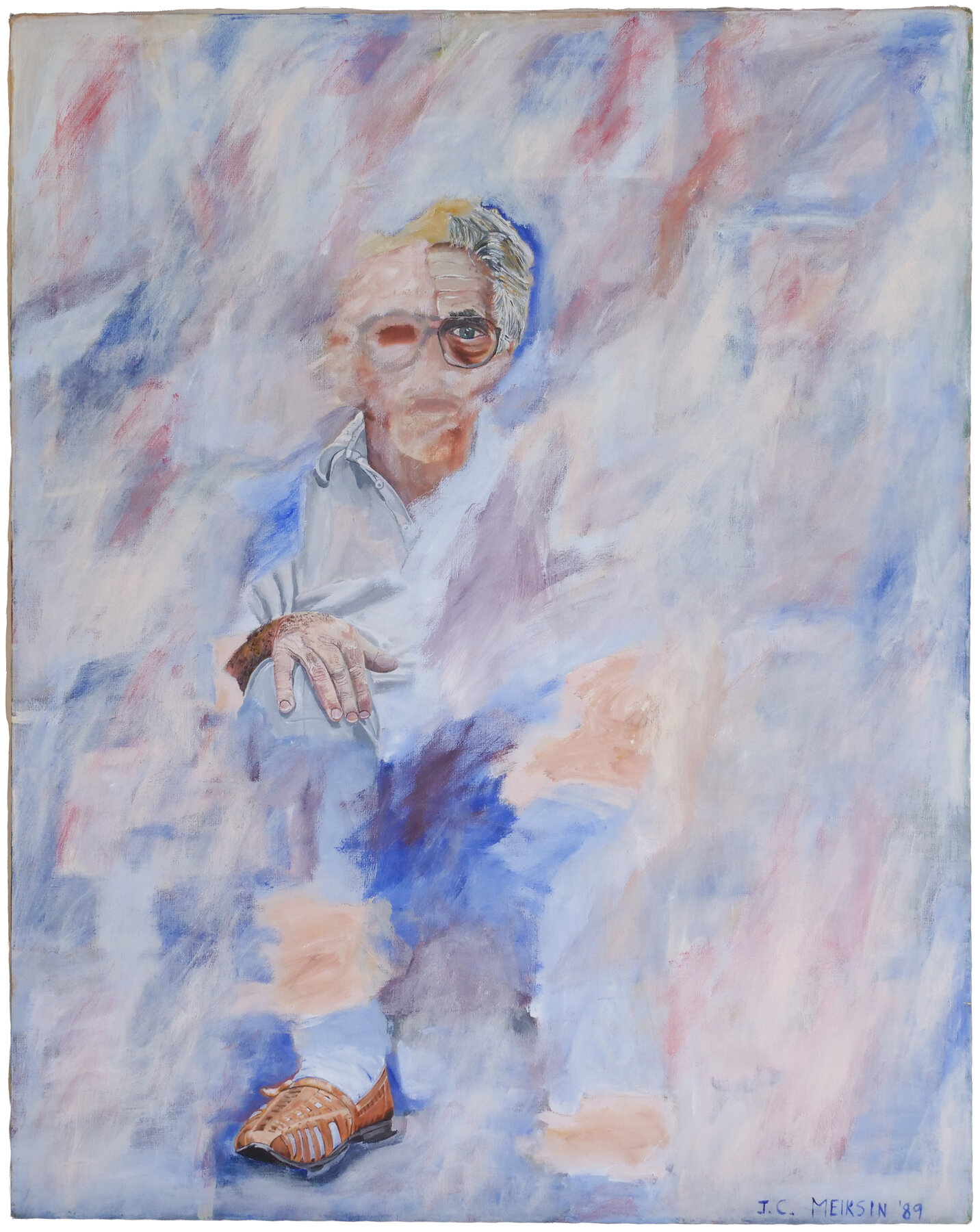
This is the first exhibition of work spanning her entire career. The paintings represent a small selection of her body of work. While the exhibited works are not for sale, many other pieces are. Visit this archive to view them. All profits will be donated to AKIM Jerusalem and the American Jewish Museum.